The NBA Has LEBRON. Now SNL Has HADER: Introducing Hadermetrics
Inspired by basketball's advanced analytics, SNL Blog introduces a new statistical model measuring cast-member contributions through dialogue, screen time, and audience engagement.
By SNL Blog Staff ·
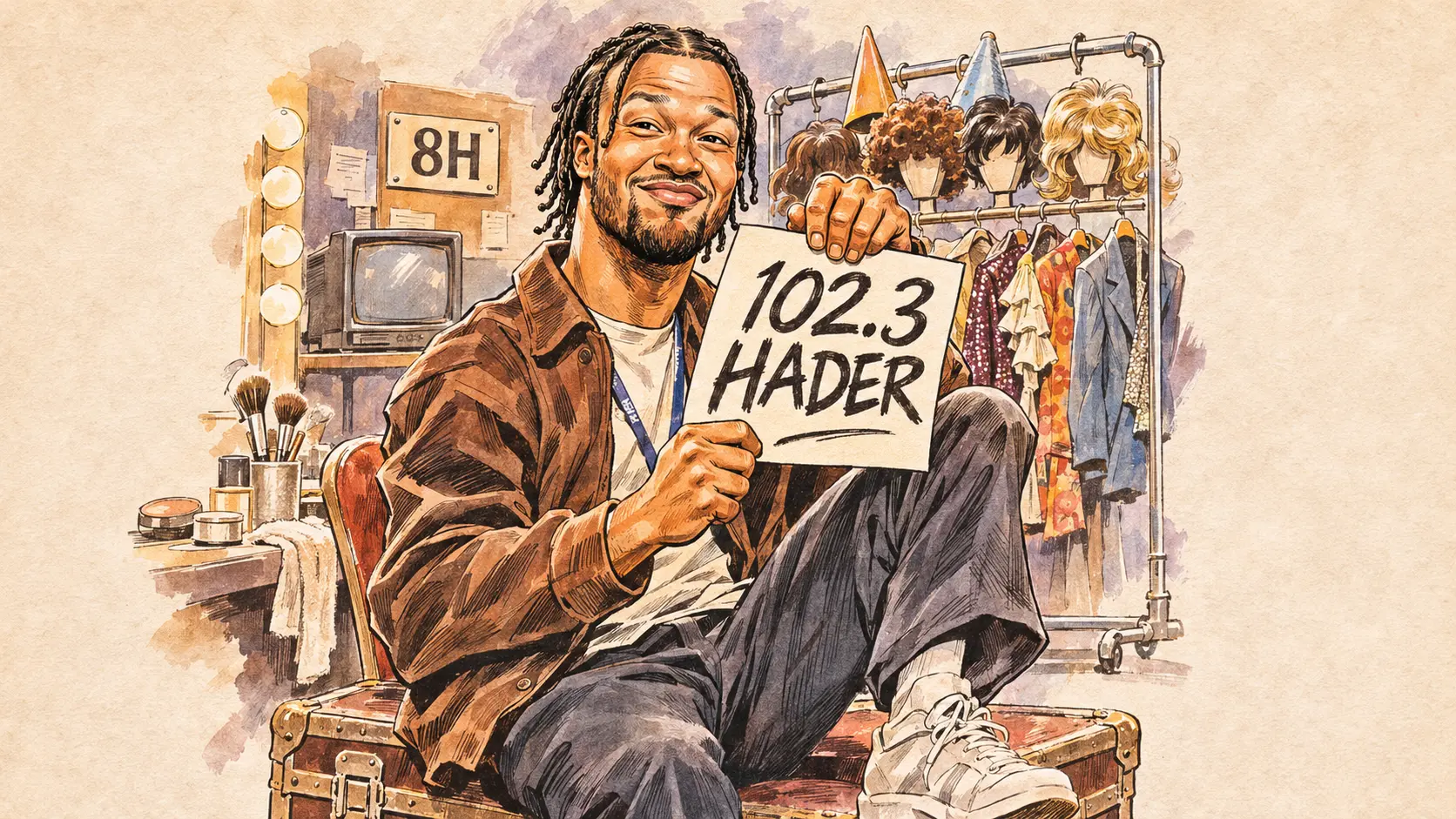
Jalen Brunson hosted the Season 52 premiere of Saturday Night Live. Naturally, we responded by developing a completely unnecessary advanced statistical model to determine who's carrying the show.
Nobody asked for advanced player analytics for a sketch comedy show. Nobody was clamoring for the equivalent of Basketball Reference, except with fewer rebounds and more impressions of Donald Trump.
But here we are.
For years, SNL fans have debated who's having a great season, who's being underutilized, who's carrying sketches, and who's getting too much airtime. We've had memorable performances, subjective rankings, YouTube views, and even meticulously tracked screen-time statistics.
What we haven't had is a way to bring these different measurements together into something resembling the advanced analytics revolution that transformed professional sports.
So we built one.
And what better time to introduce our entirely self-inflicted statistical obsession than the Season 52 premiere, hosted by New York Knicks point guard and reigning NBA Finals MVP Jalen Brunson?
Before we get to Brunson, though, let's talk about another Jalen.
Actually, a Jaylen.
The Jaylen Brown problem
Jaylen Brown had quite a season for the Boston Celtics in 2025–26.
He averaged 28.7 points, 6.9 rebounds, and 5.1 assists, earned Second Team All-NBA honors, and finished sixth in MVP voting. By traditional measures, he was one of the league's most productive players. A few months later, Boston traded him to the Philadelphia 76ers.
For anyone who follows NBA analytics, Brown also represents a familiar argument: What happens when the traditional box score and advanced statistics tell different stories?
Consider one particularly extreme example. In a 2025–26 on/off net-rating comparison, Derrick White ranked near the top of Boston's qualifying players at +7.5, while Brown was last among the nine listed at −7.9.
Sixth in NBA MVP voting. Last among those nine Celtics in that particular statistic.
Does that mean Jaylen Brown was Boston's ninth-best player? Of course not. Raw on/off statistics are influenced by teammates, opponents, rotations, and countless other variables.
But it illustrates why basketball fans have become obsessed with metrics like LEBRON, EPM, and BPM. Rather than relying exclusively on points, rebounds, and assists, these models attempt to provide additional context about a player's contributions.
And different models can reach different conclusions.
A player can score 30 points and have a relatively modest impact on winning. Another can score 12, defend brilliantly, create opportunities for teammates, and make the entire team function better.
This is where the real arguments begin.
Which brings us to Saturday Night Live.
Introducing HADER: Holistic Actor Dialogue and Engagement Rating

If basketball can have an advanced statistic named LEBRON, we see no reason SNL can't have one named HADER.
Yes, it's an acronym.
Yes, it's an homage to Bill Hader.
And no, Bill Hader has absolutely nothing to do with this project. We haven't even asked him. We assume he has better things to do.
HADER stands for Holistic Actor Dialogue and Engagement Rating, and it's the flagship statistic in our new Hadermetrics system.
The premise is simple: We want to go beyond counting how often someone appears on SNL and start measuring how much material they deliver, how prominently they're featured, and how audiences respond to the sketches they're in.
To accomplish that, we've started manually reviewing transcripts of every sketch and identifying which performer delivers every spoken word.
That allows us to track not just word counts but dialogue share, speaking turns, average words per turn (our Monologue Score), and even an admittedly ridiculous estimate of how many SNL cue cards' worth of dialogue each performer delivered.
We're also incorporating the screen-time research published by Saturday Night Network, using data collected by Mike Murray, to account for visual presence and nonverbal performances.
Finally, we look at audience reception. YouTube views tell us how widely a sketch spread. Likes provide another measure of viewer engagement. And the weekly Sketch Sorting results from Reddit's r/LiveFromNewYork community give dedicated SNL fans a voice in the equation.
Our reception model weighs those components at 65% YouTube reach, 20% YouTube like rate, and 15% Reddit Sketch Sorting rank. Sketches are compared against others from the same episode, with a limited bonus or penalty for audience reception.
At the episode level, HADER blends 70% engagement-adjusted dialogue contribution with 30% screen-time contribution.
We then scale the results into basketball-style points, because there's something profoundly satisfying about declaring that a sketch comedian dropped 62 HADER points on Saturday night.
Is this a scientifically definitive measurement of comedic talent?
Absolutely not.
It doesn't know how funny your facial expression was, whether your scene partner made your line work, or whether you saved a disastrous sketch through sheer charisma. And audience engagement doesn't prove which individual performer made a sketch popular.
But it gives us a consistent framework to examine things that previously existed as separate statistics.
And even in our first episode, the results are fascinating.
Season 52, Episode 1: The Jalen Brunson box score
On September 26, 2026, Brunson hosted the season premiere alongside musical guest KATSEYE.
We analyzed 13 aired sketch and Weekend Update segments. The cut-for-time sketch Young Rell's Crew is tracked separately and excluded from the broadcast HADER rankings.
Here's what we found.
- 1Jeremy Culhane62.1
- 2Kenan Thompson52.2
- 3Ashley Padilla43.0
- 4James Austin Johnson42.7
- 5Colin Jost41.3
- 6Mikey Day37.4
- 7Michael Che36.3
- 8Ben Marshall33.2
Jeremy Culhane dropped a 62-piece
Jeremy Culhane finished the premiere with a 62.1 HADER, leading the regular cast.
He also led the cast in screen time at 9:35, so this isn't a case of advanced metrics discovering some overlooked bench player.
But the interesting part is how he produced those numbers.
Culhane delivered 740 words across just three sketches, an average of nearly 247 words per appearance.
His Tucker Carlson commentary on Weekend Update accounted for 317 words and earned the highest Reddit Sketch Sorting score of the night at +1,108.
He added 258 words in North High, which earned another +811 from Reddit, and 165 words in Shark Tank: Respectacles.
Culhane wasn't even in the episode's two most-watched sketches, Dream Academy and the Trump cold open.
He didn't need to be.
He accumulated substantial dialogue across multiple well-received appearances, giving him the strongest overall HADER performance of the regular cast.
The box score and advanced analytics agree: Culhane was our opening-night MVP.
Tucker Carlson Reviews the Summer’s Blockbuster Films
James Austin Johnson: The Derrick White argument
Now things get interesting.
James Austin Johnson finished sixth among regular cast members in screen time, appearing on camera for 6:52.
But in HADER, he climbed to fourth with 42.7 points, ahead of performers who received more visual exposure.
The biggest reason is immediately obvious.
In the Trump/Mamdani cold open, Johnson delivered 400 of the sketch's 756 words—approximately 53% of its dialogue.
That was the largest individual word count in any aired sketch segment that night.
The cold open also accumulated approximately 6.1 million YouTube views.
Here's where the basketball analogy gets fun.
Johnson might be SNL's Derrick White. His raw minutes don't necessarily tell the whole story. Once we consider his share of the material and the audience reached by the sketches, his contribution starts looking different.
And this is where we encounter one of SNL fandom's favorite complaints.
Why does Lorne Michaels keep doing these Trump cold opens?
You can dislike the sketches. You can think they're repetitive. You can argue that political comedy shouldn't dominate the opening minutes of the show.
In fact, the Reddit Sketch Sorting thread gave this particular cold open a negative score of −60.
But the YouTube audience watched it more than six million times.
That doesn't prove viewers loved it, or that Johnson personally attracted those viewers. It does suggest that political cold opens continue to generate substantial digital attention, even when dedicated fans are less enthusiastic.
In sports terms, the Reddit scouting report and the YouTube box office are telling us different things.
HADER accounts for both.
Trump Mamdani Cold Open
Kenan Thompson: The quiet monster performance
Here's a statistic that genuinely surprised us.
Johnson delivered 400 words in the cold open.
Kenan Thompson delivered 396 words in Old Friend.
Just four fewer.
In that single sketch, Kenan was responsible for more than 55% of the dialogue, an even larger share than Johnson's in the cold open.
Yet Old Friend had approximately 837,000 YouTube views in our snapshot, compared with 6.1 million for the Trump sketch.
Same general magnitude of individual dialogue responsibility. Wildly different audience reach.
Kenan finished the episode with 848 spoken words, the highest total among regular cast members, along with 8:56 of screen time and a 52.2 HADER, good for second place.
It's a useful reminder that high-volume work in a less popular sketch shouldn't simply disappear because it didn't go viral.
HADER rewards the actual material delivered, while audience reception adjusts rather than dictates the final result.
Old Friend
Ben Marshall: The assist leader nobody noticed
Here's another one we love.
Ben Marshall delivered 479 words across five sketches and accumulated 7:17 of screen time.
That earned him a respectable 33.2 HADER, eighth among the regular cast.
But Marshall led the cast in a completely different category.
Speaking turns: 57.
More than Culhane, Kenan, Ashley Padilla, or James Austin Johnson.
Marshall averaged just 8.4 words per turn. Compare that with Culhane's 16.1 or Kenan's 18.0.
That doesn't mean Marshall was less important. It suggests his episode involved more short exchanges, setups, responses, and back-and-forth dialogue rather than lengthy uninterrupted speeches.
In basketball, we might call this the difference between a high-usage scorer and someone involved in keeping the offense moving.
Marshall also led the dialogue in Shark Tank: Respectacles, with 187 words, so he was hardly just standing around.
Maybe HADER isn't giving him enough credit. Maybe speaking turns deserve their own advanced metric.
Congratulations, we've invented another argument.
- 1Ben Marshall57
- 2Kenan Thompson47
- 3Jeremy Culhane46
- 4Ashley Padilla38
- 5James Austin Johnson38
Dream Academy: When the ensemble wins
The most-watched sketch of the premiere wasn't the Trump cold open.
It was Dream Academy, with approximately 8.4 million YouTube views, 155,000 likes, and a Reddit Sketch Sorting score of +973.
But unlike the Trump sketch, it wasn't dominated by one person's dialogue.
Grace Reiter delivered 129 words, the largest individual total in the sketch. Jane Wickline delivered 107, Veronika Slowikowska 105, and Ashley Padilla 95.
Reiter's 129 words represented just 21.5% of the sketch's 600 transcribed words.
Compare that with Johnson's 53% of the Trump cold open.
These are two very different kinds of successful comedy: one built around a dominant central performance, the other distributing its dialogue among a larger ensemble.
HADER has to recognize both without automatically assuming that the person speaking the most caused a sketch to succeed.
That's also why raw views, dialogue share, and the overall HADER score remain independently visible in our Stat Hub. A single number shouldn't erase the story behind it.
- 1Dream Academy8.4M
- 2Trump Mamdani Cold Open6.1M
Dream Academy
And what about the point guard?
Jalen Brunson did what hosts generally do: dominated the night's opportunities.
He delivered 1,270 words across nine aired segments, took 110 speaking turns, and accumulated 21:05 of screen time.
His 102.3 HADER comfortably led everyone in the episode.
We rank hosts and guests separately from the regular cast, because comparing a featured player against the person the entire episode was built around would be a little like penalizing a bench player for not getting Brunson's usage rate.
But there is something wonderfully appropriate about a basketball player setting the initial high-water mark for a basketball-inspired comedy statistic.
The point guard ran the offense.
So what does HADER actually prove?
Nothing quite as dramatic as we'd like, unfortunately.
It can't tell us definitively who's funniest. It doesn't measure joke-writing quality, individual laugh intensity, or what would have happened if a different performer had taken the role.
We also don't want to pretend that screen time and dialogue are interchangeable. A performer can generate laughs through physical comedy without saying a word, and someone delivering substantial off-camera dialogue may contribute more than their visible screen time suggests.
That's why we're keeping the original statistics available for anyone to examine.
Want to rank the cast purely by words? Go ahead.
Think screen time is a better indicator? We have that too, with credit to Saturday Night Network and Mike Murray.
Believe the r/LiveFromNewYork Sketch Sorting community has better taste than millions of YouTube viewers? You can compare those results yourself.
And if you disagree with HADER's weights, you can examine the full methodology and decide where our model falls short.
We're not pretending to have solved comedy.
We're simply giving people a new, unnecessarily elaborate way to argue about it.
Welcome to Hadermetrics
Season 52 is our starting point, and the data will grow as we review more episodes. This is a beta, so definitions and calculations may be refined as we identify limitations.
We're particularly interested in how the rankings change over time. Does a performer consistently outperform their screen-time ranking? Does someone become a breakout star because of a handful of hugely popular sketches? Can we identify the statistical difference between a dominant lead performer and an ensemble specialist?
And, most importantly, how long before somebody starts accusing us of manipulating the formula to favor Kenan Thompson?
You can explore the SNL Blog Stat Hub, read the complete Hadermetrics methodology, and send us feedback.
The NBA has LEBRON.
Now SNL has HADER.
We apologize in advance.
Data notes: Season 52 premiere, September 26, 2026. Figures reflect the supplied SNL Blog data export and can change as YouTube engagement evolves or transcripts are corrected. Cut-for-time material is excluded from broadcast HADER. Screen-time research is credited to Saturday Night Network and Mike Murray. HADER is an independent SNL Blog model, with no affiliation or endorsement from Bill Hader, NBC, or Saturday Night Network.
Snapshot checked against SNL Blog’s stored engagement figures from November 16, 2026. Dream Academy’s 600 transcribed words include 26 unattributed group words; HADER excludes those words and uses 574 individually credited words for its dialogue-share denominator. Reiter’s 21.5% above describes the transcript total, not the HADER denominator.